
A Tenancy Agreement is sometimes known as a lease. It sets out the conditions of your tenancy including things like:
The Tenancy Agreement is a legal contract between you and the owner. It allows you to live in rental housing in exchange for "valuable consideration". This usually means money or the tenant's labour. Not all agreements are covered by the Residential Tenancies Act . Check with the
Tenants Advice Service or the Ministry of Fair Trading if you are not sure, especially if you live with the owner or in a shared tenancy.
Yes. A Tenancy Agreement may be written or verbal, and it may be for a definite or an indefinite amount of time:
The Tenancy Agreement is a legally binding contract. It is important that you understand and agree with the conditions and obligations that have been included. Sometimes only the basic conditions of the Tenancy Agreement are written and others may be verbal. Avoid verbal or partially verbal agreements because they are difficult to prove. Make sure that any verbal agreements are included in your written agreement. This can include any repairs or maintenance the owner/agent has agreed to. If the owner/agent won't put it in the agreement it is an indication they may not do it when the need arises.
If you live in a flat or unit, your Tenancy Agreement may state you will agree to comply with Strata company or Body Corporate rules. If this is the case, you should ask for a copy of the rules so you know what you are agreeing to.
Yes. Your rental commitments will be agreed as part of the Tenancy Agreement. Whether the tenancy is a fixed term or periodic agreement, the rent may be paid weekly, fortnightly, monthly or at any other interval decided on by the owner and yourself.
The agreement sets out the rules of the tenancy. These are known as conditions and will guide what happens if either party breaks one of the conditions. It is important to be aware and understand all the tenancy conditions before you sign. Take the agreement home and read it carefully, get a friend to read and "witness" (sign) it.
The Residential Tenancies Act (1987) sets out the rights and responsibilities of the owner and tenant and how Tenancy Agreements may be ended. These rules are not always written into your agreement but they will automatically apply to your tenancy and can't be changed. Other parts of the Act can be changed in your agreement (see the section on contracting out below). To be legally binding these changes must be written in the agreement.
When you read the Tenancy Agreement ask the following questions to make sure you understand and agree to the conditions:
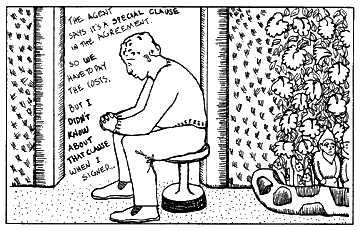
The term "contracting out" refers to clauses that can be included in your written Tenancy Agreement that change your tenancy rights as set out in the Residential Tenancies Act (1987) .
A contracting out clause may say "Sections 42 and 43 do not apply to this contract" or "Sections 40 and 45 may have been modified, excluded or restricted".
The wording of the clause allows the owner to modify or exclude sections of the Act without you knowing what they refer to or how it will affect you. Do not agree to a clause if you do not understand the sections that will be contracted out or, the implications of losing any of your rights.
The Residential Tenancies Act sets out which sections can be altered in a written Tenancy Agreement (s. 82.).
These include:
No other sections of the Residential Tenancies Act (1987) can be contracted out. For example, under no circumstances can the owner/agent take away your right to be served the correct notices before they evict you. As at July 1996 the Real Estate Institute of WA's (REIWA) Agreement to Take Residential Premises takes away some rights, as provided by the Act, including your right to do urgent repairs and claim the cost back from the owner.
Some examples of tenancy agreements can be found at the end of the Tenants' Rights Manual.
The owner must give you a copy of your agreement at the time you sign it (s54(1)(a). penalty $1000) and a booklet which sets out your rights and responsibilities (s88(2)(c) and Regulation 14 clause 2). You should also get a fully executed copy of your Tenancy Agreement within 21 days, or as soon as practical, after it is signed (s54(1)(b). penalty $1000).
Back to Entering into a Tenancy menu