Going to court is usually a last resort action if you and the owner have a dispute you can't sort out. You can apply straight to the court to try and sort out the problem. This may be appropriate if the owner has indicated they will not do what you ask. Otherwise it is usually more appropriate to try and resolve the problem before going to court.
The dispute might be about the owner's failure to meet their responsibilities to you (such as for repairs and maintenance, or your privacy and quiet enjoyment of the premises) or the owner's claim that you have failed to meet your responsibilities (such as to pay the rent owing and keep the place reasonably clean and undamaged). The dispute might also be about the return of bond monies and/or whether the tenancy should be terminated.
You should go to the court if you want to take action against the owner, or if the owner takes action against you.
Do not withhold your rent to try and make the owner fix the problem (eg repairs). You will be in breach of your tenancy agreement and the owner can take action against you.
The Small Disputes Division (SDD) is a special section of the Local Court set up to deal with disputes between owners and tenants under the Residential Tenancies Act.
Applications for hearings must be lodged at the Local Court closest to the address of the property being rented. If you are unsure, check with the Local Court. It may be possible for another Local Court to hear an application if both the owner and tenant give their consent at the time of lodging the application.
No! The SDD is a relatively low cost, informal court. Tenants and owners (parties to the proceedings) represent themselves. A party may be represented by their agents, if the court is satisfied that:
It is quite common for private owners to be represented by a Real Estate Agent, and for Homeswest to be represented by one of its Regional Recovery officers. It is not common for tenants to be represented by an agent. However, you can ask the court for permission to have a person act on your behalf.
If you are representing yourself but would like some support, you can have a "friend" in court to help by taking notes, quietly giving advice and providing support (McKenzie v McKenzie). The "friend" may not address the court or act on your behalf without the court's permission.
A party may only be represented by lawyers in special circumstances; for example, if both parties agree and the court is satisfied that it will not unfairly disadvantage the other party, or if one of the parties is a legally qualified person (s.22(3)).
You may have to wait two to three weeks before your dispute is heard. Urgent applications may be listed at short notice. Waiting times for hearings vary from court to court. Further information can be obtained from the Clerk of Courts at the Local Court.

You will be charged an application fee ($26.70 as at July 1996) when taking a dispute to the SDD. You may be able to get the fee reduced (to $19.70 as at July 1996) if you are on a low income and can prove this to the court. It is up to the clerk whether to grant you a concession. You can include the refund of the fee as a claim on your application. The court may order the owner to pay the application cost to you if you are successful.
You will be charged $18.00 if applying to defend a bond dispute. You will be charged this fee when the owner/agent applies to court on a Form 6 and you have to lodge a Form 5 stating why you dispute the owner/ agent's claims See section 5.2 Applying to the Local Court for a Bond Disposal Order for more information
The Residential Tenancies Act (1987) allows the court to make various orders.
The court can issue an order to:
To apply for a hearing you must lodge an application form with the Local Court. There are two types of application forms.
A Form 12 Application
You must lodge this form for a general dispute, and sometimes if you are trying to recover bond money not lodged in a joint account, or are applying for the return of your bond and other orders.
This application form asks for you (the applicant) and the owner's (the respondent) details. You should name the owner as the respondent, even if the property is managed by an agent. If you do not know the owner's address list it as care of the agent's address. If you're not sure about the owner's name check your tenancy agreement; the name should be written there.
This form 12 application has 2 main sections:
As a general rule, while in the court you can only raise the issues and request the orders listed on the application form. The court can allow an amendment to your application (s. 20) but this is not guaranteed. You should try to list all the problems when you apply.
A Form 6 Application
You must lodge this application for bond disputes when the bond is held by the Bond Administrator, in a joint bank account or a Tenancy Bond Trust Account.
You must provide the following information:
For further information see section 5.2 Applying to the Local Court for a Bond Disposal Order .
This is called making a cross application. A cross application is made when a form 12 application has been made to the court and the other person wants to have their claim heard at the same time.
Cross applications do not apply if the owner has applied on a form 6. If the owner has applied on a form 6 ( Application for Disposal of Bond Money ) you will be sent a form 5 ( Notice of Intention to Dispute Application for Disposal of Bond Money ) to make your response or cross application.
A cross application may be necessary if you believe there are issues which should be taken into account by the court but they are not stated on the owner's application.
This is because the court may only hear matters which have been listed for hearing. If you try to bring up other issues, the court may not be able to hear them and you would have to apply separately about those matters; even if you believe they should be heard at the same time.
A cross application is made on a form 12 (see "A Form 12 Application" above). When you lodge your form with the court you should ask that it carry the same "Plaint number" as the owner's application (this is the number given to the owner's application and can be found in the top right hand corner of the application form). Take the owner's application with you so that it can be listed for hearing at the same time.
Some Local Courts will not charge a fee for such a cross application, as they consider it to be part of the dispute. However, others do charge the usual filing fee and may even require your cross application to carry a different Plaint number.
When the matters are heard by the court, the person hearing the case may choose to hear them both at the same time, or one then the other. See section 6.3 Preparing for Court for more information on how to prepare for the hearing.
Before appearing in court, the Clerk may ask if you and the owner/agent want to try and come to an agreement at a Conciliation Conference. This is not compulsory. If you prefer, you can go straight to court. However, it is a good opportunity to find out what the owner wants to present to the court and if there is any chance of settling the matter.
If you work out a solution with the owner/agent at the Conciliation Conference it may be confirmed in court as a Consent Order without you having to go through a full hearing. A consent order is binding, the same as if your case had been heard in the court.
It may not be necessary to go before the court, but if you do, clearly state the terms of what has been agreed so the court can write it up as an order.
You should arrive at the court before the listed hearing time and notify the Bailiff (court official) that you are there. The court will have informed the owner/agent of the hearing date and time. Yours will not be the only case listed for a hearing at that time so you may have to wait to be called into the court. Sometimes it can take several hours so you might like to take some reading material and refreshments to keep you going! If you have children its a good idea if child care can be arranged or if someone can go with you to the court to look after them while your case is being heard.
If the owner/agent does not appear, tell the court that you want the hearing to go ahead and that you oppose any adjournment (putting the hearing off for another day) because you need the problem resolved as soon as possible.
If there was no Conciliation Conference, the court may ask you and the owner/agent to go outside and try to solve the problem before the hearing starts. If you reach an agreement the court may confirm it as a Consent Order. Do not agree to anything you are not happy with. If your dispute is not sorted out the court will hear your case.
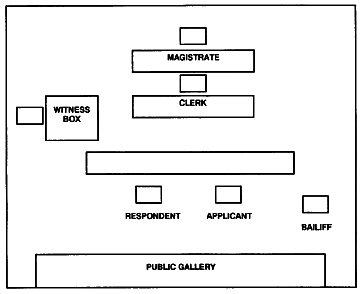
Each court has its own way of conducting a hearing, so what happens might be different to what is written on this information sheet. The general process is:
If you lodged a form 12 application you should be allowed to speak first. If you lodged a form 6 application the court may hear from the owner/agent first.
You should take prepared notes to help you give clear evidence and remind you of what to say. Use your notes only as a prompt as the court will expect you to present evidence from memory.
When presenting the case you should:
Once you have presented your case, the magistrate (or clerk) may ask you some questions and will then ask the respondent (the owner or agent) if they would like to cross examine you. This means that the owner/agent may ask you questions.
Answer questions clearly and accurately, but only respond to questions relevant to the dispute. A question like "Do you always pay your rent on time?" may not be relevant to whether the owner should have done necessary repairs and you can ask the court if you have to answer it. Take your time and if you do not know or cannot remember something just say so.
You may then call your witnesses (if you have any) and ask them questions. Your witnesses answers will be evidence. Your witnesses may be cross-examined by the owner.
When the owner/agent is asked to tell their side of the story you should listen carefully and take notes on anything you disagree with. When the owner/agent has finished the court will ask if you want to question (cross examine) the witness. Say yes if you want to ask any questions or challenge any evidence they have given. You should question the owner/agent about anything they have said which is not true or is only partly true. If you don't question the owner/agent's evidence the court may think that you do not dispute the information. You will get a chance to question the owner/agent's witnesses once they have presented their evidence. The magistrate or clerk may also ask some questions.
Once all the evidence has been presented the court will make a decision and read it out. You should receive a copy of the order from the court in the mail a few days later. Make sure the court has your right address so you get the order.
After the hearing, please contact the Tenants Advice Service to let us know how it went, and any suggestions for other tenants going to court.
If the court order is to pay money
If the court has ordered the payment of money and the money is not repaid, the person who is owed the money has the choice to:
If either of these circumstances apply to your case you should seek advice from Legal Aid , a financial counsellor or a community legal centre .
If the court order is to evict
If an order is made that you must give "vacant possession" of the premises, this means you and all your belongings must be out of the premises by the date stated by the court. If you are not out by then you can be physically removed.
You should leave the premises in the same condition as when you first moved in, less fair wear and tear. If you don't, the owner/agent can seek another order that you pay for anything that needs fixing. It is good to have a witness to the condition you left the premises in. Write out your own property condition report and have your witness sign it.
If you have left any of your belongings at the premises you should try to arrange with the owner to get them back. Any arrangements should be confirmed in writing. See section 4.6 Abandoned Premises and Goods for more information on what happens to goods left at premises.
Back to Going to Court menu