Tenant Databases are sometimes called "Tenant Blacklists". The Databases are lists of tenants that an owner/agent says are a bad risk, or in some cases a "good" tenant. A Company (database operator) who sells access to the Database keeps this list.
Owners and agents can use a database by paying a fee to the company that keeps the list. An owner/agent can contact the company to put a tenant's name on the list, or they can find out if another owner or agent has listed a tenant.
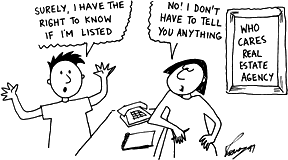
There are no laws covering Tenant Databases or any other controls over what information is collected or given out. Tenants have no right to know if they are listed or why. Tenants do not have a right to correct or delete wrong information about them on a tenant database. It is up to the database operator to manage the database, decide what information will be kept and whom it will be given to.
Tenant Advice Service (TAS) believes that these lists are against tenants' right to privacy; and that the controls similar to those applying to databases used by credit providers (such as The Credit Reference Association) should apply to Tenant Databases. Some of the controls that we think should apply to Tenant Databases are:
YES. A number of standard application for tenancy forms and tenancy agreements include a part (clause) saying that the tenant agrees to be listed on a Tenant Database if they breach their agreement. The breach does not have to be serious - it is up to the owner/agent. For example, one tenant thought they had been listed on a database because they were two days late with their rent!
Because there are no controls over Tenant Databases there isn't a whole lot you can do at the moment to protect yourself from being listed. Do beware of any clause saying you agree to be listed. You can try to negotiate one or more of the following, although your success will largely depend on the attitude of the owner/agent you are dealing with:

If the owner/agent is threatening to list you on a database to force you to do something that you don't have to do, they may be committing an offence (section 338A of the Criminal Code ). This section talks about threats made with the intention of influencing a person. For example, an owner/agent may say: "If you don't agree to sign the bond disposal form for all of your bond to be paid to me, I will put you on a database and you will never be able to rent in this state again", even though the tenant had a right for the bond to be refunded (in whole or part). The threat to force the tenant to do something they were lawfully entitled to refuse to do, may be an offence.
If this has happened to you, you can make a complaint to the police. Even if the police don't take the owner/agent to court, there will be a record that this happened. You should be given a complaint slip by the police which may be used in evidence if you need to go to court, and the owner/agent will know that what they have done is wrong.
You should get legal advice if you think you have been threatened.
If your name has been listed on a tenant database you can:
Contact TAS if you would like more information about going to court to make an application about a Database listing.
There has been broad agreement among tenant and real estate groups that privacy protection should be extended to the private sector and include tenant databases. The Privacy Commissioner supported the need for a privacy regime in the private sector to regulate tenant (and other) databases and recommended that privacy laws be extended to the private sector.
In March 1997 the Prime Minster announced that the Government had decided not to proceed with privacy legislation for the private sector at this stage but is supportive of the private sector undertaking voluntary measures to meet privacy standards, for example, through codes of conduct.
TAS and other tenant organisations throughout Australia believe there is still a need for national privacy legislation to control Tenant Databases. However, this seems unlikely at the moment. We are therefore exploring whether a strong enough national Code of Practice could be introduced as an alternative way of regulating Tenant Databases until legislation is introduced. There are also some moves to introduce State based privacy laws in some States, but not Western Australia at the moment.
Tell your local MP, the Prime Minister and other relevant Federal and State politicians about the need for a law to protect privacy in the private sector to cover Tenant Databases.
Write to the following people, tell them your story of the problems you have had and why you want laws and controls over Tenant Databases. Ask them to take action to make sure your right to privacy is protected. Send a copy of your letter/s to TAS.

The Hon. John Howard
Prime Minister
Parliament House
CANBERRA ACT 2600
The Hon. Daryl Williams
Commonwealth Attorney General and Minister for Justice
Parliament House
CANBERRA ACT 2600
Senator Nick Bolkus
Shadow Attorney General
Parliament House
CANBERRA ACT 2600
Mr Peter Reith
Minister for Small Business and Consumer Affairs
Parliament House
CANBERRA ACT 2600
Mr Peter Foss
WA Attorney General and Minister for Justice
12th Floor Dumas House
2 Havelock Street
WEST PERTH WA 6005
Mr Doug Shave
Minister for Fair Trading
11th Floor Dumas House
2 Havelock Street
WEST PERTH WA 6005
Mr Nick Griffiths
Shadow Attorney General
Parliament House
Ms Allanah McTiernan
Shadow Minster for Fair Trading
Parliament House
Back to General Information menu