There are always a number of things that must be done at the end of the tenancy see section 5.1 Getting the Bond Money Back
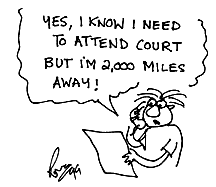
At the end of the tenancy you may be moving a long way away, interstate or even overseas. If you are going to be moving a long distance away at the end of the tenancy you should take a few simple steps to try and protect yourself.
The most common issue that will arise at the end of the tenancy is a dispute about bond, see section 5.1 Getting the Bond Money Back .
As with any dispute, first try to negotiate and always confirm arrangements in writing. If negotiation is not successful an application will have to be made to the court to hear both sides of the story and decide what is fair in the circumstances, see section 6.2 Going to Court for more information.
You may encounter problems if your case is going to be heard in court but you can't be there personally. The Local Courts in WA do not provide for telephone link-ups or for evidence to be given in a court elsewhere.
If you are still in WA you may be able to arrange for your case to be heard nearer where you are living now. However the owner / agent must agree with this arrangement.
If the owner / agent will not agree for the case to be heard in a different Local Court in WA; or if you are now living interstate or overseas, it will be much more difficult for you to successfully defend claims or take action. If the owner / agent is proceeding to court and you cannot get there you will need to try and make arrangements for someone to be there on your behalf.
The Residential Tenancies Act 1987 allows you to be represented by another person if you can't be there yourself and the owner / agent won't be disadvantaged by you having someone to speak for you (s22(2)).
It is very important that you give written permission for a particular person to represent you in Court (see sample letter below). This can either be sent to the Court in advance or given to your representative to hand up at the start of the hearing.
You should note in the written permission that you are appointing your representative in accordance with section 22(2) of the Residential Tenancies Act 1987.
Sample Letter
(Your Name)
(Your Current Address)
(Date)
Dear Sir / Madam
My name is (your name) and I was the tenant of (the address of the rented premises) from (date tenancy started) until (date you vacated the property) .
Since the end of the tenancy I have relocated to (place where you now live) and I am unable to return to (place where the court hearing is) at this time.
I have asked (name of person representing you) to represent me in this matter. I am appointing this person as my representative under section 22 (2) of the Residential Tenancies Act 1987.
Yours sincerely
(Your Name)
The purpose of the court hearing is to allow the person hearing the case, usually a Magistrate, to make a decision based on the law, and the evidence presented by both the tenant and the owner / agent. If you have moved far away, you will have difficulty presenting your evidence to the court.
The Residential Tenancies Act states that the Court "shall not be bound by the rules of evidence but may inform himself upon any matter relating to the proceedings in such a manner as he thinks fit." (s22)
The "rules of evidence" are a complex set of legal rules that usually govern what evidence may be given in Court, and how evidence is to be given. One aspect of this is that there are rules about receiving documents into evidence, for example, if a photograph is to be used, the person who took the photo should be there to prove they took it and when. In Residential Tenancies Act matters, even though the rules of evidence don't apply, it is likely that the evidence will be given more weight if the photographer is there.
As you will not be there you should prepare a sworn statement where you write your evidence down, the reason you are unable to attend the hearing, declare that what you are saying is the truth and sign the statement. You can do this by making a statutory declaration. You can get a statutory declaration form from a Newsagent.
It is always better to have a witness, or yourself appear in court and give oral (verbal) evidence about your dispute. This allows the owner / agent to ask you questions and allows the magistrate to hear you give your answers. This is called "tested" evidence, and is always given more weight than "untested" evidence.
You can assist your representative by preparing questions you would like them to ask the witnesses in cross-examination. Your representative can use these questions to try and challenge ("test") the owner / agent's evidence. The Magistrate may also ask questions to "test" the evidence.
Of course no-one can question or "test" a written statement. Your sworn statement to the court will be "untested".
The Court will prefer tested evidence when it is different to untested evidence (e.g. if the owner / agent is present at court and gives evidence that can be "tested" then the court will probably prefer the owner / agent's evidence. This is the problem for tenants who can't be there at the hearing.
However, it is always worth trying to defend yourself against unreasonable claims. The only cost involved is the cost of the application and your time. If the owner / agent applies to Court and you don't contest their unfair claims, they may not even be required to prove their case. Rather, an order can simply be made in their favour.
Your representative may be able to negotiate a reasonable settlement for you in a "conciliation conference". This is where both parties negotiate an agreement, often immediately before the hearing. The Court can then write the agreement up as a Court order. You will need to give your representative written authority to act for you if you want them to negotiate. You should always be clear with your representative as to what is your bottom line.
Back to Going to Court menu